

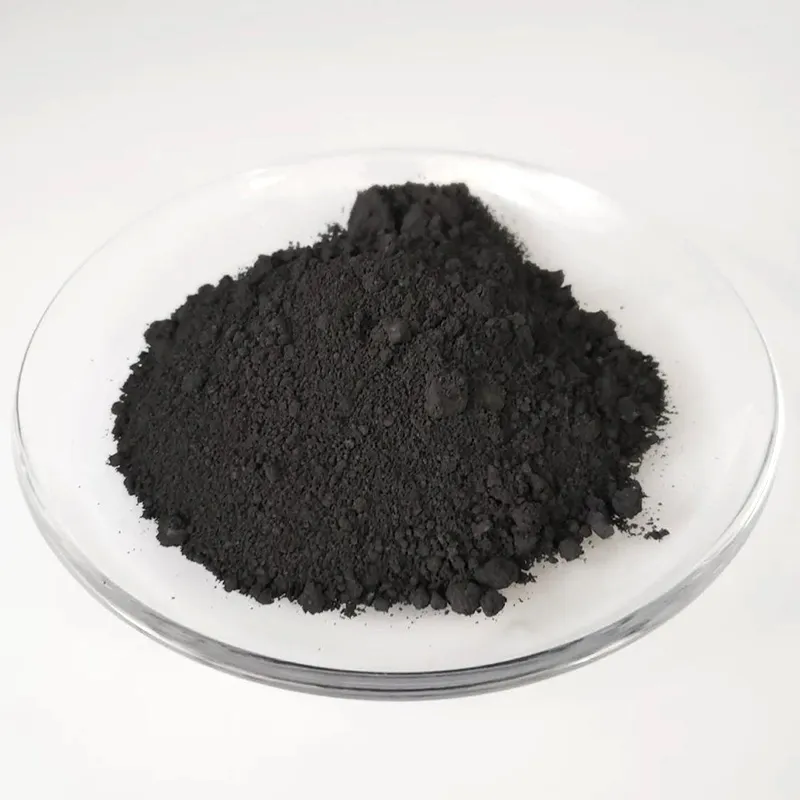
Product Description
Iron Oxide Black is an inorganic iron oxide pigment primarily composed of magnetite, with the chemical formula Fe3O4. It is identified by CAS 12227-89-3 and commonly classified as C.I. Pigment Black 11, C.I. 77499. Its mixed-valence iron oxide structure gives the material its characteristic black appearance and magnetic behavior.
The pigment is used in formulations that require dark coloration in construction materials, protective coatings, printing inks, plastics, and rubber products. In cement-based applications, it can be used to develop dark concrete, paving blocks, tiles, and other architectural surfaces. In coatings, the pigment may contribute to black or gray shades in suitable primer and finish systems.
Unlike a soluble dye, Iron Oxide Black colors materials through the distribution of solid pigment particles. Particle size, surface characteristics, pigment concentration, and dispersion quality all influence the finished appearance. The pigment's magnetic response may also be relevant in selected technical applications, but magnetic performance should not be assumed without testing the actual grade.
Commercial materials can vary in Fe3O4 content, particle-size distribution, shade, moisture, water-soluble salts, pH, and oil absorption. These factors affect processing and final-product performance. For consistent production results, select the material according to the intended application and verify the relevant parameters using the current technical specification and Certificate of Analysis (COA).
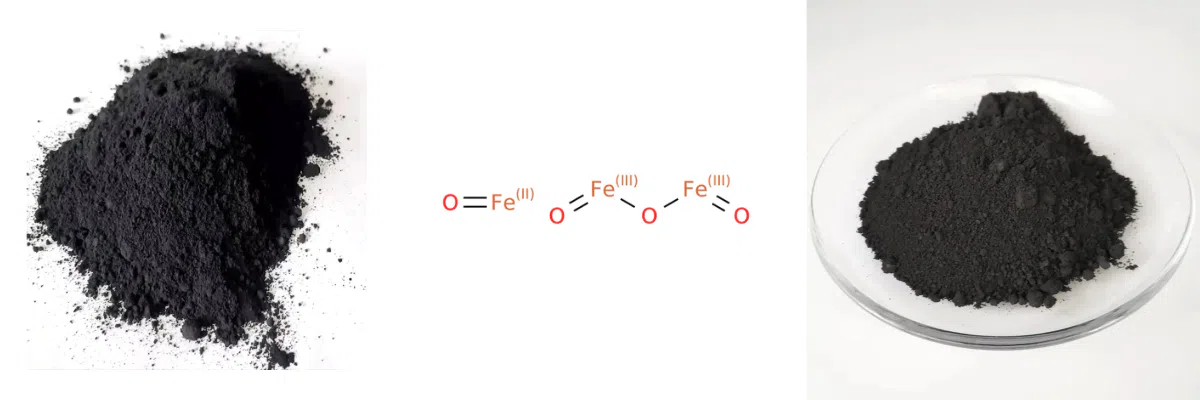
Chemical Properties
| Property | Details |
|---|---|
| Product Name | Iron Oxide Black |
| CAS Number | 12227-89-3 |
| Chemical Name | Iron(II,III) oxide |
| Common Synonyms | Black Iron Oxide; Ferrosoferric Oxide; Magnetite |
| Color Index Name | C.I. Pigment Black 11 |
| Color Index Number | C.I. 77499 |
| Molecular Formula | Fe3O4 |
| Molecular Weight | Approximately 231.54 g/mol |
| Chemical Class | Inorganic mixed-valence iron oxide |
| Appearance | Typically black to dark reddish-black powder |
| Water Solubility | Insoluble in water |
| Alcohol Solubility | Generally insoluble in alcohol |
| Acid Behavior | Can dissolve in strong acids; behavior depends on acid type and conditions |
| Magnetic Properties | Magnetically responsive; actual performance depends on particle characteristics and grade |
| Typical Application Areas | Construction materials, coatings, inks, plastics, rubber, and selected technical materials |
| Key Grade Parameters | Fe3O4 content, shade, particle size, moisture, water-soluble salts, pH, and oil absorption |
| Storage | Keep the container tightly closed in a dry, well-ventilated area and follow the supplied safety documentation |
Product Applications
1. Concrete and Cement Products
Iron Oxide Black can be used to color concrete blocks, paving stones, cement tiles, mortar, and other cement-based materials. The required dosage should be established through trial batches because cement composition, aggregate color, water content, and curing conditions can affect the final shade.
2. Protective and Architectural Coatings
The pigment may be incorporated into compatible primers, industrial coatings, and architectural paint systems to produce dark finishes. Formulators should evaluate pigment dispersion, binder compatibility, film appearance, and the required corrosion or weathering performance.
3. Printing Inks
Selected grades can be evaluated for black or dark-tone ink formulations. Relevant considerations include particle fineness, dispersion stability, print appearance, substrate compatibility, and the requirements of the printing process.
4. Plastic and Rubber Coloring
Iron Oxide Black may be used to color compatible plastic and rubber compounds. Grade selection should account for processing temperature, polymer type, residence time, dispersion equipment, and the desired shade.
5. Ceramic and Building Materials
The pigment can be considered for suitable ceramic products, tiles, and other mineral-based materials. Testing under actual firing or processing conditions is necessary to determine shade development and compatibility.
6. Magnetic Material Research
Because Fe3O4 is magnetically responsive, suitable grades may be evaluated in laboratory studies involving magnetic materials and particulate systems. This application requires appropriate characterization of particle size, magnetic response, purity, and material behavior.
7. Color Matching and Product Development
Iron Oxide Black can be used to adjust dark shades in pigment blends and industrial formulations. Small-scale trials help determine the required loading, evaluate dispersion quality, and establish reproducible color targets.

FAQ
Q1: What is Iron Oxide Black?
Iron Oxide Black is an inorganic pigment primarily composed of Fe3O4, also known as iron(II,III) oxide or magnetite. It is used to provide black and dark shades in suitable materials.
Q2: What are the CAS number and molecular formula?
The CAS number is 12227-89-3, and the molecular formula is Fe3O4. The commonly reported molecular weight is approximately 231.54 g/mol.
Q3: Is Iron Oxide Black soluble in water?
No. Iron Oxide Black is generally insoluble in water and is incorporated into formulations by dispersing the solid pigment particles.
Q4: Is Iron Oxide Black magnetic?
Fe3O4 has magnetic properties. However, the measured response of a commercial pigment depends on its composition, particle characteristics, and physical form. Confirm the required magnetic specifications if this property is important to the application.
Q5: Which industries use Iron Oxide Black?
Common application areas include construction materials, coatings, printing inks, plastics, rubber, ceramics, and selected magnetic-material research. The appropriate grade depends on the process and performance requirements.
Q6: What should be checked before purchasing?
Review the CAS number, Fe3O4 content, shade, particle size, moisture, water-soluble salts, pH, oil absorption, and any application-specific test data. Request the current COA and technical specification for the grade being supplied.


