

Product Description
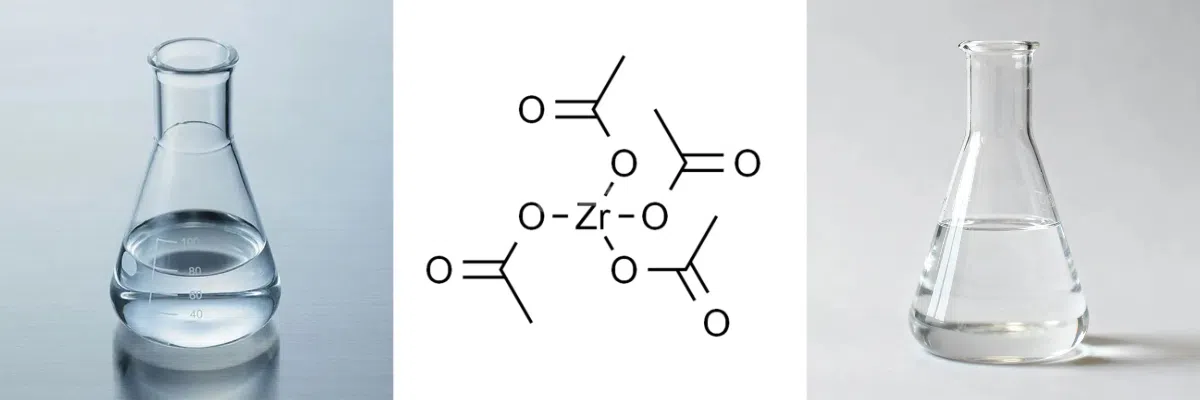
Zirconium acetate is a zirconium-containing chemical used in selected industrial formulations and material-treatment processes. Identified by CAS 7585-20-8, it is associated with acetate ligands and may be supplied as an aqueous solution or in another specified form. Its exact composition can vary with the product's preparation, concentration, and degree of basicity, so the commercial material should be characterized by its own technical specification rather than by a single assumed molecular formula.
In aqueous grades, zirconium acetate is typically supplied as a clear, colorless to pale-amber liquid. The solution may be acidic, and its density, zirconium content, and stability depend on concentration and formulation. These properties influence how the material should be diluted, metered, and incorporated into a process.
Zirconium acetate is used in selected coating and surface-treatment systems, as well as in formulations where zirconium-based crosslinking or material modification is required. It may also serve as a precursor in the preparation of zirconium-containing materials. Performance depends on the substrate, pH, concentration, temperature, and compatibility with other formulation components.
For industrial use, it is important to distinguish zirconium acetate solution from basic zirconium acetate and other zirconium-containing compounds. Similar names do not guarantee identical composition, zirconium concentration, or application performance. Before introducing the material into production, evaluate its compatibility with the intended formulation and confirm any required process adjustments through a controlled trial.
When purchasing, specify the required physical form and zirconium content, rather than relying on the product name alone. Review concentration, density, pH or acidity, appearance, relevant impurity limits, and storage conditions. Request the current Technical Data Sheet (TDS), Safety Data Sheet (SDS), and batch-specific Certificate of Analysis (COA). If a particular molecular formula or assay is required, verify that it corresponds to the actual grade being supplied.
Chemical Properties
| Property | Details |
|---|---|
| Product Name | Zirconium Acetate |
| CAS Number | 7585-20-8 |
| Common Chemical Name | Acetic Acid, Zirconium Salt |
| Chemical Class | Zirconium-containing acetate compound |
| Composition | Depends on the specific grade, degree of basicity, and supplied form |
| Molecular Formula | Grade-dependent; verify against the supplier's specification |
| Molecular Weight | Depends on the defined chemical composition; do not assume a single value for all commercial grades |
| Appearance | Solution grades are commonly clear and colorless to pale amber; other forms may differ |
| Physical State | Often supplied as an aqueous solution; confirm the offered grade |
| Odor | May have a faint acetic-acid-like odor; follow the SDS for exposure precautions |
| Zirconium Content | Grade- and concentration-dependent |
| Density | Concentration- and temperature-dependent; confirm by COA or TDS |
| pH / Acidity | Grade-dependent; confirm using the specified test method |
| Water Compatibility | Aqueous grades are water-based; dilution compatibility should be checked for the intended system |
| Main Functional Role | Zirconium source for selected surface treatments, coating formulations, crosslinking systems, and material synthesis |
| Storage | Keep in a tightly closed, compatible container and follow the grade-specific SDS for temperature, ventilation, and storage conditions |
Zirconium acetate is not represented by one universally applicable formula or specification across all commercial forms. Use the exact composition, concentration, and test values documented for the supplied grade.
Product Applications
1. Coatings and Surface Treatments
Zirconium acetate may be incorporated into selected coating or surface-treatment formulations where zirconium-based interactions can help modify adhesion, surface performance, or resistance properties. Compatibility should be assessed for each substrate and formulation.
2. Crosslinking and Resin Modification
In suitable systems, zirconium acetate can contribute to crosslinking or modification of functional polymer and resin formulations. Its effectiveness depends on the chemistry of the resin, pH, concentration, and curing conditions.
3. Paper and Textile Treatment
Selected paper and textile processes may use zirconium-containing formulations to modify surface characteristics or treatment performance. The appropriate grade and treatment conditions depend on the material, processing sequence, and required end-use properties.
4. Leather Treatment
Zirconium-based acetate formulations may be used in selected leather-processing operations. Process suitability depends on the formulation, substrate, treatment conditions, and the quality requirements of the finished material.
5. Zirconium-Based Material Preparation
Zirconium acetate can serve as a precursor in the preparation of zirconium-containing materials. The conversion route, hydrolysis conditions, and subsequent heat treatment depend on the intended material and process design.
6. Industrial Formulation Development
In research, pilot production, and industrial formulation work, zirconium acetate may be evaluated as a zirconium source or functional additive. Preliminary testing should establish stability, compatibility, dosage, and the effect on the final product before scale-up.

FAQ
Q1: What is the CAS number of zirconium acetate?
A: The CAS number associated with zirconium acetate is 7585-20-8. Buyers should also confirm the supplied grade's composition and physical form.
Q2: Does zirconium acetate have one fixed molecular formula?
A: Not across all commercial grades and composition descriptions. Different records may refer to different acetate, basic acetate, or solution compositions. Use the formula and composition stated in the current product specification.
Q3: Is zirconium acetate supplied as a liquid or a solid?
A: It is commonly available as an aqueous solution, although other specified forms may exist. Confirm the physical form, concentration, and zirconium content before ordering.
Q4: What is zirconium acetate used for?
A: Selected uses include coatings, surface treatments, resin modification, crosslinking systems, leather or textile treatment, and preparation of zirconium-containing materials. Suitability depends on the grade and process.
Q5: Which specifications should be confirmed before purchase?
A: Confirm physical form, zirconium content, concentration, density, pH or acidity, appearance, relevant impurity limits, packaging, and storage conditions. Request the current TDS, SDS, and batch COA.
Q6: How should zirconium acetate be stored and handled?
A: Follow the storage and handling requirements for the exact grade. Keep the container closed, use compatible packaging, and apply suitable protective equipment and exposure controls as specified in the SDS.


