

Product Description
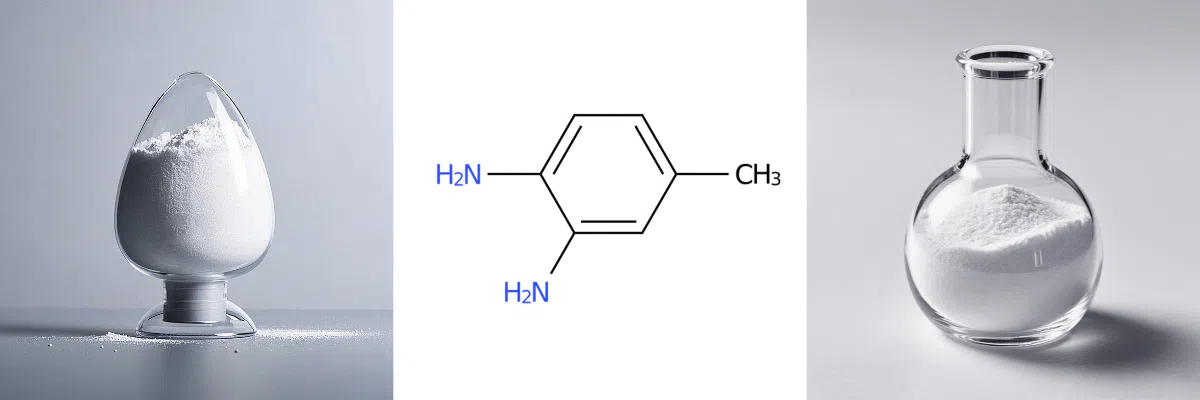
3,4-Diaminotoluene, also known as 3,4-Toluenediamine or 4-Methyl-o-phenylenediamine, is an aromatic diamine with the molecular formula C₇H₁₀N₂ and CAS number 496-72-0. Its IUPAC name is 4-methylbenzene-1,2-diamine, and its molecular weight is approximately 122.17 g/mol.
The molecule consists of a benzene ring bearing one methyl group and two neighboring amino groups. This substitution pattern distinguishes 3,4-Diaminotoluene from other toluenediamine isomers, which can differ in reactivity and suitability for downstream synthesis. Correct isomer identification is therefore an important part of raw-material selection, particularly when a manufacturing process has been developed around a specific intermediate.
3,4-Diaminotoluene is used in dye-related chemistry and can serve as a building block in the preparation of selected specialty chemicals. The two amino groups provide reaction sites for appropriate chemical transformations, while the methyl-substituted aromatic ring contributes to the structure of the resulting compound. Actual suitability depends on the target molecule, reaction conditions, purity requirements, and impurity sensitivity of the downstream process.
The material is typically supplied as a crystalline solid or powder. Reported appearance can range from white or light-colored material to greyish or brownish shades, depending on the product condition and grade. For this compound, appearance should be evaluated together with analytical data rather than used as the sole indicator of quality. Some commercial products may contain different toluenediamine isomers, so buyers should verify that the offered material is specifically identified as CAS 496-72-0 rather than assuming that all toluenediamine grades are equivalent.
When evaluating a supply option, purchasers should review the assay method, melting-point range, isomer identity, impurity profile, packaging integrity, and storage recommendations. Because 3,4-Diaminotoluene presents significant health hazards, procurement should also include review of the current safety data sheet and confirmation that the intended facility is equipped to handle the material safely.
3,4-Diaminotoluene Chemical Properties
| Property | Details |
|---|---|
| Product Name | 3,4-Diaminotoluene |
| CAS Number | 496-72-0 |
| Molecular Formula | C₇H₁₀N₂ |
| Molecular Weight | 122.17 g/mol |
| IUPAC Name | 4-Methylbenzene-1,2-diamine |
| Common Synonyms | 3,4-Toluenediamine; 4-Methyl-o-phenylenediamine |
| Chemical Class | Aromatic diamine |
| Functional Groups | Two amino groups and one methyl-substituted benzene ring |
| Appearance | Crystalline solid or powder; reported colors range from light-colored to greyish or brownish |
| Melting Point | Approximately 89–92°C for a reported high-purity grade; confirm against the supplied product specification |
| Boiling Behavior | A reported reference value is approximately 265°C; verify the measurement conditions and suitability of this value for the supplied grade |
| Solubility | Reported soluble in methanol; solubility in other solvents depends on the solvent and test conditions |
| Typical Industrial Role | Chemical intermediate, including applications in dye-related synthesis |
| Storage Considerations | Protect from air exposure and follow the supplier's specified cool, dry, and light-protected storage conditions; inert-gas protection may be specified for some grades |
| Safety Considerations | Harmful exposure and other serious health hazards are reported; consult the current product-specific SDS before handling |
Product-specific technical note: 3,4-Diaminotoluene should not be confused with other positional isomers of toluenediamine or with an isomer mixture. The distinction can affect reaction performance and the impurity profile of downstream products. If the material is intended for a tightly controlled synthesis, request analytical confirmation of the isomer identity in addition to the assay result. A melting-point range can help with incoming quality checks, but it does not replace a suitable analytical method or the batch COA.
Product Applications
1. Dye and Colorant Intermediate Manufacturing
3,4-Diaminotoluene has documented use in dye manufacturing. Its aromatic diamine structure makes it relevant to selected synthesis routes where the specific substitution pattern is needed to build the target colorant molecule.
2. Specialty Chemical Synthesis
The compound can be used as a starting material or intermediate in the preparation of selected specialty chemicals. The appropriate reaction pathway depends on the target structure and the required control of residual starting materials and by-products.
3. Derivative Preparation and Condensation Chemistry
Its adjacent amino groups can participate in suitable derivatization or condensation reactions. Process developers should validate reaction conditions, selectivity, and product purity for each intended derivative rather than assume identical behavior across different substrates.
4. Chemical Research and Process Development
Appropriate research or industrial grades may be used to investigate reaction pathways, evaluate synthesis conditions, or develop analytical procedures. The grade should be selected according to the experimental purpose and the required level of impurity control.
5. Corrosion-Inhibitor and Specialty Material Research
Aromatic diamines and their derivatives are relevant to some specialty-material synthesis pathways, including research into corrosion-inhibiting compounds. Use of 3,4-Diaminotoluene in a specific route should be confirmed by the process design and supplier documentation; it should not be assumed that every application of related diamines applies to this isomer.
6. Upstream Intermediate Evaluation for Industrial Chemical Supply Chains
Manufacturers supplying specialty or agricultural chemical sectors may evaluate 3,4-Diaminotoluene where a validated synthesis route specifically requires this intermediate. Its relevance is process-dependent and does not establish it as a direct-use agricultural chemical, pesticide, or crop treatment.

FAQ
Q1: What is 3,4-Diaminotoluene CAS 496-72-0?
It is an aromatic diamine with the molecular formula C₇H₁₀N₂ and molecular weight of approximately 122.17 g/mol. It is also known as 3,4-Toluenediamine or 4-Methyl-o-phenylenediamine.
Q2: What is 3,4-Diaminotoluene used for?
Its documented uses include dye manufacturing and chemical synthesis. Other potential applications depend on whether the specific 3,4-isomer is suitable for the target reaction.
Q3: Is 3,4-Diaminotoluene the same as other toluenediamine isomers?
No. The positions of the amino groups differ between isomers, which can influence their chemical behavior and downstream suitability. Confirm the CAS number and isomer identity when ordering.
Q4: What should buyers check in the product specification?
Review the assay, analytical method, isomer identity, melting-point range, impurity profile, appearance, and batch COA. Storage and handling requirements should also be confirmed through the current SDS.
Q5: What precautions are important when handling 3,4-Diaminotoluene?
The substance has significant health hazards, including risks associated with ingestion, skin contact, and inhalation; some safety classifications also identify serious long-term hazards. Follow the current product SDS, use suitable workplace exposure controls and protective equipment, and ensure trained personnel manage the material.


