

Product Description
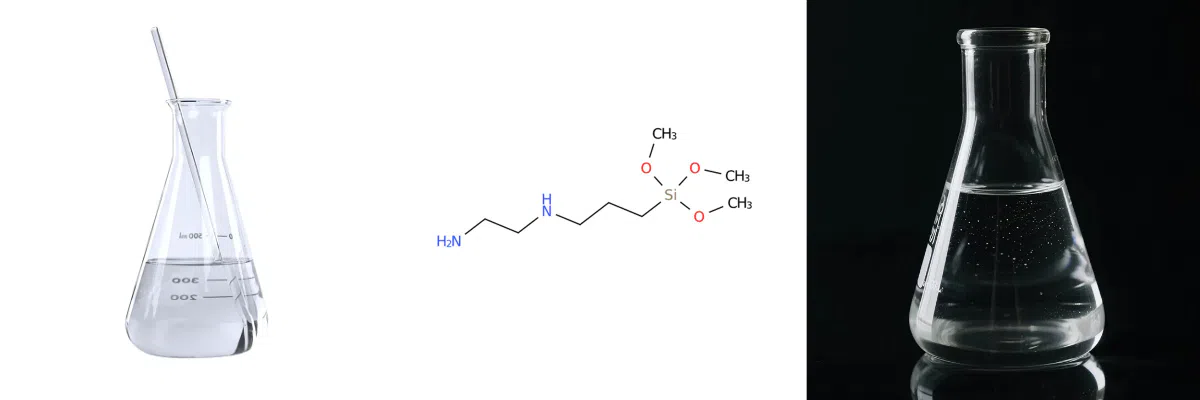
N-(2-Aminoethyl)-3-aminopropyltrimethoxysilane is an amino-functional organosilane identified by CAS number 1760-24-3. It is also known as 3-(2-Aminoethylamino)propyltrimethoxysilane and N-(3-Trimethoxysilylpropyl)ethylenediamine. Its molecular formula is C₈H₂₂N₂O₃Si, with a molecular weight of approximately 222.36 g/mol.
The molecule combines an organic diamine-related segment with a silicon atom bearing three methoxy groups. This arrangement gives the compound two complementary functions: the nitrogen-containing portion can interact with compatible organic materials, while the alkoxysilane portion can undergo hydrolysis and subsequent condensation reactions. These reactions can support bonding or surface modification at interfaces between inorganic substrates and organic formulations.
When exposed to moisture under suitable conditions, the methoxy groups can hydrolyze to form silanol groups, releasing methanol. The resulting silanol species may condense with hydroxyl groups on surfaces such as glass, silica, and certain mineral fillers, or react with other silanol groups to form siloxane linkages. Actual bonding depends on surface chemistry, moisture level, pH, temperature, and treatment procedure.
This chemistry makes the compound relevant to formulations in which adhesion to glass or mineral surfaces is important. It can also be evaluated in resin systems containing inorganic fillers, where interfacial compatibility may influence mechanical properties, filler dispersion, and resistance to moisture-related degradation. Performance is formulation-specific; the presence of an amino silane alone does not guarantee a particular adhesion strength or durability.
Because the compound contains hydrolyzable methoxy groups and reactive amine functionality, moisture exposure and compatibility with other ingredients deserve particular attention during storage and formulation. Premature hydrolysis or condensation may change the material's behavior, while the amine groups can influence curing reactions and formulation stability. Selection should therefore account for the resin chemistry, substrate, application method, and intended curing conditions.
Chemical Properties
| Property | Details |
|---|---|
| Product Name | N-(2-Aminoethyl)-3-aminopropyltrimethoxysilane |
| Common Name | 3-(2-Aminoethylamino)propyltrimethoxysilane |
| Alternative Chemical Name | N-(3-Trimethoxysilylpropyl)ethylenediamine |
| CAS Number | 1760-24-3 |
| Molecular Formula | C₈H₂₂N₂O₃Si |
| Molecular Weight | Approximately 222.36 g/mol |
| IUPAC Name | N′-(3-Trimethoxysilylpropyl)ethane-1,2-diamine |
| InChIKey | PHQOGHDTIVQXHL-UHFFFAOYSA-N |
| Chemical Class | Amino-functional organosilane |
| Main Functional Groups | Amine-related nitrogen functionality and trimethoxysilyl group |
| Typical Physical Form | Liquid |
| Appearance | Commonly clear to pale-yellow liquid; grade-dependent |
| Water Behavior | Methoxy groups hydrolyze in the presence of water; behavior depends on pH and conditions |
| Hydrolysis Byproduct | Methanol |
| Primary Function | Silane coupling and interfacial surface modification |
| Typical Substrates | Glass, silica, selected mineral fillers, and compatible inorganic surfaces |
| Storage Consideration | Protect from moisture and keep in tightly closed, compatible packaging under the conditions specified for the supplied grade |
Product Applications
1. Glass Surface Treatment
The compound can be used to modify glass surfaces before applying compatible coatings, adhesives, or resin systems. Hydrolysis and condensation of its silane groups may help establish interfacial bonds, depending on the surface preparation and treatment conditions.
2. Mineral-Filled Polymer Composites
In selected composite formulations, the silane may be applied to compatible mineral fillers to improve interaction between the filler surface and an organic polymer matrix. The effect depends on filler chemistry, surface treatment, polymer type, and dispersion quality.
3. Adhesives and Sealants
The compound can be evaluated as a coupling ingredient in adhesive and sealant systems that need to bond to glass or mineral substrates. Its amine functionality may also interact with certain reactive formulation components, so compatibility and curing behavior should be assessed.
4. Protective Coatings
In suitable coating systems, this amino-functional silane can support adhesion to inorganic surfaces and contribute to interfacial stability. Its use should be matched to the binder chemistry, substrate preparation, moisture conditions, and curing process.
5. Glass Fiber and Reinforced Materials
The compound may be considered in selected glass-fiber or mineral-reinforced systems where interfacial bonding between inorganic reinforcement and an organic matrix is important. The treatment method and silane concentration need to be tailored to the reinforcement and resin system.
6. Surface Modification of Silica and Mineral Substrates
The hydrolyzable trimethoxysilyl groups make the compound relevant to surface modification of suitable hydroxyl-bearing substrates. Applications may include silica-containing materials and selected mineral surfaces, provided that the treatment conditions support the desired surface reaction.
FAQ
Q1: What is N-(2-Aminoethyl)-3-aminopropyltrimethoxysilane?
It is an amino-functional organosilane with CAS number 1760-24-3 and molecular formula C₈H₂₂N₂O₃Si. It is used in selected coupling and surface-modification applications.
Q2: What is the role of the trimethoxysilyl group?
The methoxy groups can hydrolyze to form silanol groups, which may then condense with suitable surface hydroxyl groups or with other silanol groups. These reactions can contribute to interfacial bonding under appropriate conditions.
Q3: Why does this silane contain amine functionality?
The nitrogen-containing portion provides chemical functionality that can interact with compatible organic materials and influence formulation behavior. Its effect depends on the resin, curing chemistry, and other ingredients.
Q4: Can this compound be used with any resin?
No. Compatibility varies with resin chemistry, pH, moisture content, and curing conditions. Preliminary testing is important, particularly for systems in which amine functionality may alter curing or storage stability.
Q5: What should be considered when storing this material?
Its hydrolyzable methoxy groups make moisture control important. Keep the container tightly closed and follow the storage and handling requirements specified for the actual supplied grade.
Q6: What is the difference between this compound and an aminopropyltrimethoxysilane with only one amine group?
This compound contains an additional aminoethyl segment, giving it a different nitrogen-containing structure. The two substances should not be treated as interchangeable because their molecular structures and formulation behavior can differ.


